What is CRISPR and how does it work?

In recent years, the word CRISPR has become widely known. It appears in news stories, documentaries, science books, and even conversations about medicine and technology. But what exactly is it, and why is it generating so much interest?

CRISPR is a tool that allows scientists to modify DNA with great precision. It’s used to correct genetic errors, engineer cells to fight diseases like cancer, and even improve the crops we grow. Although it may sound like science fiction, it’s already being used in labs around the world and has transformed the way genetic research is conducted.

What does CRISPR mean?

CRISPR stands for Clustered Regularly Interspaced Short Palindromic Repeats. These special sequences were discovered in bacteria, which use them as a defense mechanism against viruses. When a virus attacks a bacterium, the bacterium can save a fragment of the virus’s DNA as a kind of memory. If the virus attacks again, the bacterium recognizes it and uses an enzyme to cut and destroy it.

Scientists studied this natural system and thought: “If bacteria can cut DNA precisely, could we use this system to edit the DNA of other organisms?” This idea led to the development of CRISPR as a genetic editing tool.
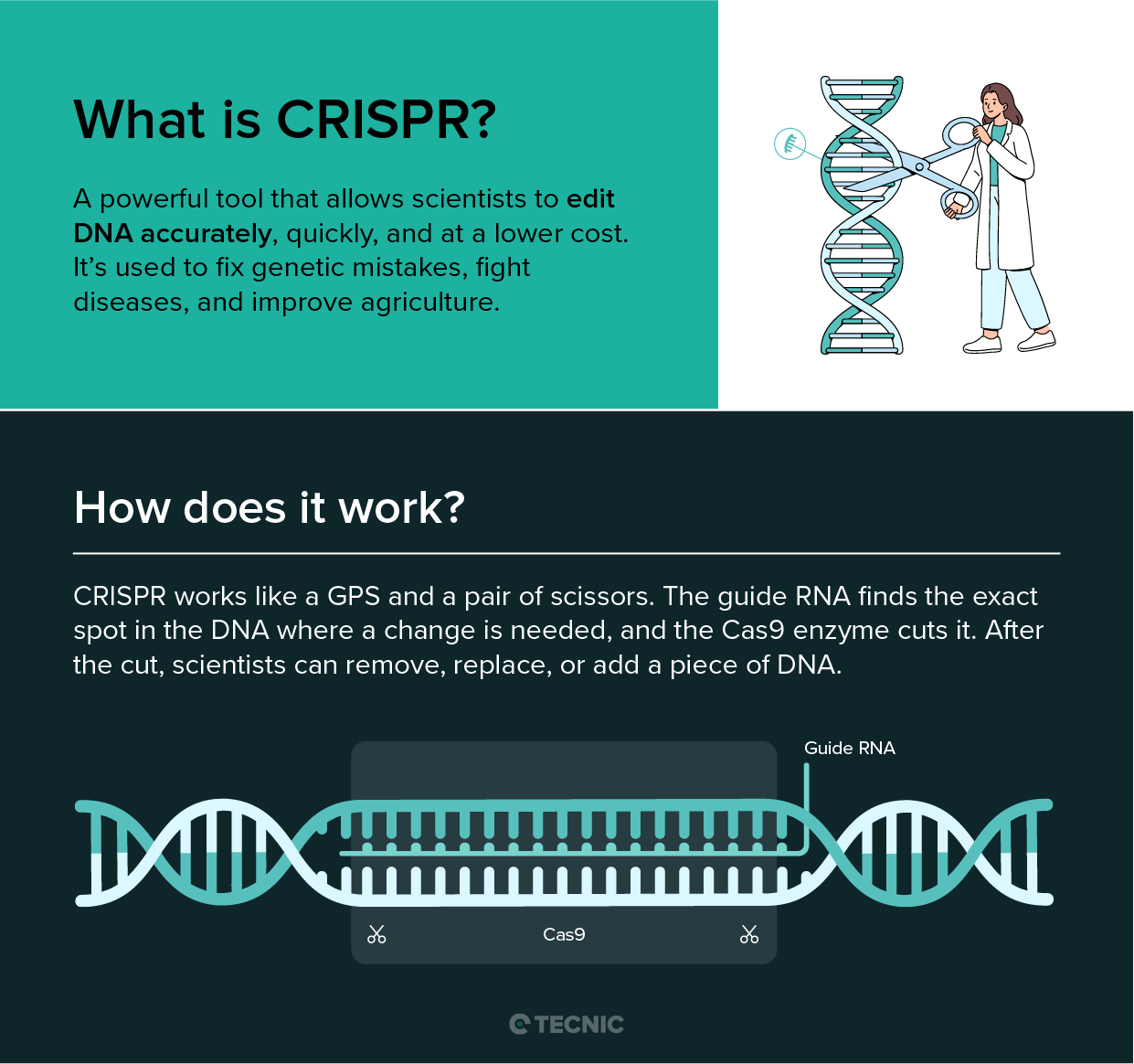
Infographic explaining what CRISPR is and how it works, illustrating DNA gene editing with guide RNA and the Cas9 enzyme. Includes TECNIC logo.

How does CRISPR work?

CRISPR works with two main components that function together:

  • A guide RNA, which acts like a GPS to find the exact location in the DNA where a change is needed.
  • An enzyme called Cas9, which acts like molecular scissors that cut the DNA at the targeted point.

Once the DNA is cut, scientists can delete, change, or insert specific sequences. For example, they can remove a gene that causes a disease or insert a new one that functions better. This enables highly accurate edits to the genome of any organism.

What makes CRISPR special is that it’s faster, cheaper, and more precise than previous genetic editing techniques. It can also be applied to many types of cells and organisms, from bacteria to humans.

What is CRISPR used for?

CRISPR is already being used in several areas of science and technology:

  • Health: It is being explored for treating genetic diseases like sickle cell anemia, cystic fibrosis, and certain types of inherited blindness. It's also being studied for fighting infectious diseases like HIV.
  • Cancer: Researchers are testing it to modify immune cells so they can better recognize and destroy cancer cells.
  • Agriculture: CRISPR helps develop crops that are more resistant to disease, drought, or climate changes. It can also improve the shelf life or taste of fruits and vegetables.
  • Science: It allows researchers to study the function of specific genes, understand how genetic changes affect organisms, and explore new ways to prevent or treat diseases.

In the future, it could even be used to eliminate genes that cause allergies or to manufacture drugs directly inside the human body.

Concerns and debates

Although this gene editing technology is very promising, it also raises important questions:

  • Is it ethical to change a baby’s DNA before birth?
  • What if these changes are passed on to future generations?
  • Could this technology be used to create "enhancements" in healthy individuals?
  • Who decides how and when this technology can be used?

These questions concern not only scientists, but also governments, international organizations, and society at large. The decisions made today could have lasting consequences, so it’s essential that CRISPR is used responsibly and under proper regulation.

The future of CRISPR

CRISPR is improving every day to become safer and more precise. In the future, it may help cure currently untreatable diseases, prevent genetic disorders before they appear, and even help stop pandemics.

It’s also being combined with other technologies like artificial intelligence, which helps identify the right genes faster, or nanotechnology, which could improve how the editing system is delivered into the body

In addition, CRISPR is expected to play a key role in personalized medicine, enabling treatments tailored to each patient, with higher effectiveness and fewer side effects. This could fundamentally change how we approach health and medicine.

Companies like TECNIC are developing solutions that apply these technologies safely, using advanced equipment and platforms that automate processes, ensure quality, and meet pharmaceutical industry regulations.

Conclusion

CRISPR is a powerful tool that is transforming how we understand and treat many diseases. It allows us to edit DNA with precision, opening new doors in medicine, agriculture, and research. It’s a technology that could improve the quality of life for millions of people around the world.

At TECNIC, we support these advances and work to ensure the technology is applied safely, responsibly, and efficiently. Our mission is to provide solutions that help labs, hospitals, and companies harness the potential of CRISPR in a fast, secure, and science-driven way.

What is CRISPR and how does it work?

Frequently Asked Questions (FAQ)

1. What is CRISPR used for?

It’s used to edit DNA, treat diseases, improve crops, and advance genetic research.

2. Who discovered CRISPR?

It was first identified in bacteria. Scientists like Emmanuelle Charpentier and Jennifer Doudna adapted it for gene editing.

3. How is CRISPR different from older gene-editing tools?

It’s faster, cheaper, and more accurate than earlier methods like TALENs or ZFNs.

4. Does CRISPR work on all types of cells?

It works on many, but editing efficiency and safety depend on the cell type and method used.

5. What does Cas9 do in CRISPR?

Cas9 is an enzyme that cuts the DNA at a specific spot chosen by the guide RNA.

Subscribe to our newsletter

Newsletter Form

Contact form

Your opinion is very important to us, and we encourage you to contact our sales team to discuss the purchase of our bioprocess equipment. We are here to answer your questions and help you find the best solution for your needs.

Quote
Related Content

Quote

Quote
Image to access to all TECNIC's features, you can see a person working with the ePilot Bioreactor.

Coming soon 

We are finalizing the details of our new equipment. Soon, we will announce all the updates. If you want to receive all the latest news about our products, subscribe to our newsletter or follow our social media channels. 

Newsletter Form

Sign Up

Stay informed about our product innovations, best practices, exciting events and much more! After signing up for our newsletter, you can unsubscribe at any time.

Newsletter Form

Cassette

We understand the importance of flexibility and efficiency in laboratory processes. That's why our equipment is designed to be compatible with Cassette filters, an advanced solution for a variety of filtration applications. Although we do not manufacture the filters directly, our systems are optimized to take full advantage of the benefits that Cassette filters offer.

Cassette filters are known for their high filtration capacity and efficiency in separation, making them ideal for ultrafiltration, microfiltration, and nanofiltration applications. By integrating these filters into our equipment, we facilitate faster and more effective processes, ensuring high-quality results.

Our equipment, being compatible with Cassette filters, offers greater versatility and adaptability. This means you can choose the filter that best suits your specific needs, ensuring that each experiment or production process is carried out with maximum efficiency and precision.

Moreover, our equipment stands out for its 100% automation capabilities. Utilizing advanced proportional valves, we ensure precise control over differential pressure, transmembrane pressure, and flow rate. This automation not only enhances the efficiency and accuracy of the filtration process but also significantly reduces manual intervention, making our systems highly reliable and user-friendly.

Hollow Fiber

We recognize the crucial role of flexibility and efficiency in laboratory processes. That's why our equipment is meticulously designed to be compatible with Hollow Fiber filters, providing an advanced solution for a broad spectrum of filtration applications. While we don't directly manufacture these filters, our systems are finely tuned to harness the full potential of Hollow Fiber filters.

Hollow Fiber filters are renowned for their exceptional performance in terms of filtration efficiency and capacity. They are particularly effective for applications requiring gentle handling of samples, such as in cell culture and sensitive biomolecular processes. By integrating these filters with our equipment, we enable more efficient, faster, and higher-quality filtration processes.

What sets our equipment apart is its 100% automation capability. Through the use of sophisticated proportional valves, our systems achieve meticulous control over differential pressure, transmembrane pressure, and flow rate. This level of automation not only boosts the efficiency and precision of the filtration process but also significantly diminishes the need for manual oversight, rendering our systems exceptionally reliable and user-friendly.

Contact General

Cellular configuration

The cellular configuration of the eLab Advanced is equipped with a pitched-blade impeller designed to support efficient mixing for cell culture processes in both laboratory development and early scale-up. The blade geometry promotes mainly axial flow, helping to distribute gases, nutrients and pH control agents uniformly throughout the vessel while keeping shear stress at a moderate level. This makes it suitable for mammalian, insect and other shear-sensitive cell lines when operated with appropriate agitation and aeration settings. In combination with the vessel aspect ratio and baffle design, the pitched blade supports stable foaming behavior and reproducible oxygen transfer, which is essential when comparing batches or transferring processes between working volumes.

Operators can fine-tune agitation speed to balance oxygen demand and mixing time without excessively increasing mechanical stress on the culture. 

Cellular configuration

The cellular configuration of the eLab Advanced is equipped with a pitched-blade impeller designed to support efficient mixing for cell culture processes in both laboratory development and early scale-up. The blade geometry promotes mainly axial flow, helping to distribute gases, nutrients and pH control agents uniformly throughout the vessel while keeping shear stress at a moderate level. This makes it suitable for mammalian, insect and other shear-sensitive cell lines when operated with appropriate agitation and aeration settings. In combination with the vessel aspect ratio and baffle design, the pitched blade supports stable foaming behavior and reproducible oxygen transfer, which is essential when comparing batches or transferring processes between working volumes.

Operators can fine-tune agitation speed to balance oxygen demand and mixing time without excessively increasing mechanical stress on the culture. 

Cellular configuration

The cellular configuration of the eLab Advanced is equipped with a pitched-blade impeller designed to support efficient mixing for cell culture processes in both laboratory development and early scale-up. The blade geometry promotes mainly axial flow, helping to distribute gases, nutrients and pH control agents uniformly throughout the vessel while keeping shear stress at a moderate level. This makes it suitable for mammalian, insect and other shear-sensitive cell lines when operated with appropriate agitation and aeration settings. In combination with the vessel aspect ratio and baffle design, the pitched blade supports stable foaming behavior and reproducible oxygen transfer, which is essential when comparing batches or transferring processes between working volumes.

Operators can fine-tune agitation speed to balance oxygen demand and mixing time without excessively increasing mechanical stress on the culture. 

Microbial configuration

The microbial configuration of the eLab Advanced is equipped with a Rushton turbine specifically designed for high-oxygen-demand processes such as bacterial and yeast fermentations. The radial-flow impeller generates strong mixing and intense gas dispersion, promoting high oxygen transfer rates and fast homogenization of nutrients, antifoam and pH control agents throughout the vessel. This makes it particularly suitable for robust microbial strains operating at elevated agitation speeds and aeration rates.

Operators can adjust agitation and gas flow to reach the required kLa while maintaining consistent mixing times, even at high cell densities. This configuration is an excellent option for users who need a powerful, reliable platform to develop and optimize microbial processes before transferring them to pilot or production scales.